Oil
MN Commodities is a Downstream Wholesale Marketer with activities in the oil and gas industry from a refinery onwards – ie, the distribution and marketing of hydrocarbon products as an agent or facilitator who acts as an intermediary on behalf of energyproducers by finding and selling to energy consumers. Alternately, MN Commodities as a marketer may sell to any party in the supply chain who is downstream from the producer. Trading of oil and gas, utilities and mining commodities has moved from being a contract-focused specialist activity to occupy a more centre stage role in the strategies of companies in these sectors. Energy market liberalisation, carbon markets, increased participation from investment banks and hedge funds, and greater interplay between physical, future, over the counter and exchange traders markets, have all added to the scope and complexity of commodities trading and risk management.
The sale of any commodity to a party who intends to resell that commodity to other parties is referred to as a wholesale transaction. In the energy industry, wholesaling is distinguished from retailing primarily by the regulatory environment that governs wholesale transactions and the distances travelled by the energy. Interstate wholesale transactions fall under regulations in the world, and even most non-customer sales within the same state are referred to within the industry as retail sales. Wholesale energy sales can be made between producers, marketers, brokers, utility companies and select high-volume end-use customers. The most common form of wholesale energy transaction made between energy producers or marketers and utility companies who serve the general public.
Crude oil
A full-ranging hydrocarbon mixture produced from a reservoir after any associated gas has been removed. Among the most commonly traded crudes are the North Sea’s Brent Blend, the US’s West Texas Intermediate (WTI) and Dubai. West Texas Intermediate (WTI) US crude oil used as a benchmark for pricing much of the world’s crude oil production.
Fuel oil
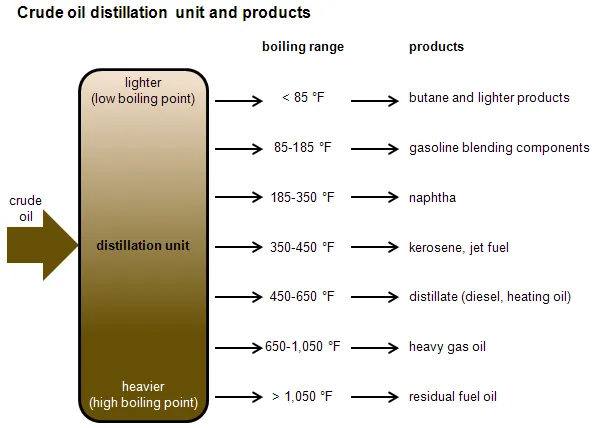
Heavy refined distillates. Used to fuel power stations, district heating plants, ships, industry and as a fuel for household heating. The different fuel oil grades are classified according to their viscosity and sulphur content.
Gasoil/Automotiv Gas Oil (AGO) EN 590 ppm
European designation for No. 2 heating oil and diesel fuel. Light oil Lighter fuel oils distilled off during the refining process. Virtually all petroleum used in internal combustion and gas turbine engines is light oil.
Kerosene and Jet Fuels
Kerosene is a light refined product (C6-C16) that has a lower boiling point range than diesel/No. 2 fuel oils. Jet-A (freeze point of -40°C) and Jet-A1 (freeze point of -47°C) are highly refined kerosene- type fuels used in commercial and general aviation turbine engines. Jet fuel is a clear to straw- colored fuel, based on either an unleaded kerosene (Jet A-1), or a naphtha-kerosene blend (Jet B). Similar to diesel fuel, it can be used in either compression ignition engines or turbine engines.
Naphtha
A volatile, colourless product of petroleum distillation. Used primarily as a paint solvent, cleaning fluid, and blendstock in gasoline production.
Gasoline
A light-end hydrocarbon distillate used for internal combustion engines actively traded as futures and options contracts on the New York Mercantile Exchange.